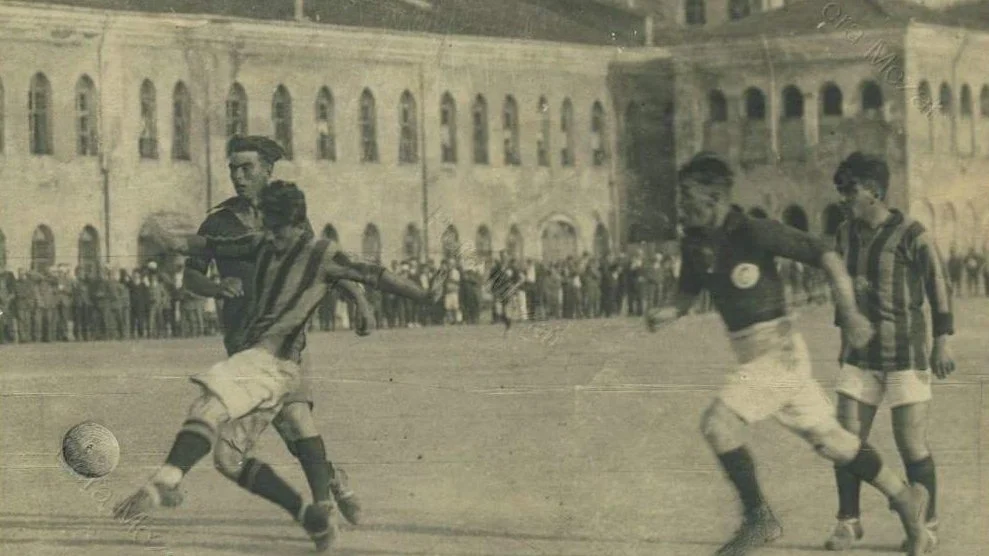
The history of the football ball is, on the evidence currently sourced, a story of three steps: a vulcanised rubber ball, a lighter inflatable bladder, and then written rules from the English Football Association on weight and size. One source reports that Charles Goodyear made the first vulcanised rubber soccer ball in 1855, and says this helped begin standardising the ball’s size and shape. That date is often disputed and rests on a single page, so it is reported here, not confirmed.
The same source says an inflatable rubber bladder was introduced later. It was lighter than Goodyear’s ball and held its shape better. Roughly a decade after that, it reports, the Football Association issued regulations on the ball’s weight and size. The source does not name the bladder’s inventor or give a year for it, and it does not date the regulations, so none are given here.
Quick answer: One source reports that Charles Goodyear made the first vulcanised rubber soccer ball in 1855, which helped begin standardising the ball’s size and shape. The date is disputed and awaits a second authoritative source. An inflatable rubber bladder, lighter and better at keeping its shape, came later, and the English Football Association then issued weight and size rules. The bladder’s inventor, its year and the year of the rules have not been verified.
Where the football came from
Before the football became a standard piece of equipment, it was an unstandardised object. In the 1800s, the era this story begins in, the ball used in kicking games had no single agreed shape, size or weight. That is the starting point for everything that followed, and it is the problem each later change set out to solve.
The sources reviewed for this article do not describe early materials in a way that has been verified, so this section does not name them. What the one source we have read does say is that the ball’s size and shape only began to be standardised once rubber entered the picture. That puts the early ball firmly in a world without shared rules: two matches could be played with two quite different balls.
A word on the part that matters most in this story. A bladder is the inflatable inner chamber of a ball, the part that holds the air. The outer covering gives a ball its surface and its feel, but the bladder determines how well it keeps its shape. Much of the history of the football is a story of what the bladder was made from and how the cover was built around it.
The first landmark in the sourced record is reported rather than settled. According to Malvern Panalytical, in a history of the soccer ball published on its knowledge centre, Charles Goodyear made the first vulcanised rubber soccer ball in 1855. Vulcanising is a process that makes rubber tougher and more durable. The same source says this ball began the standardising of size and shape.
Two cautions apply. The 1855 date rests on that single page and is often disputed, so it should be read as a reported claim, not a confirmed one. And the source itself does not say who introduced the later inflatable bladder or in which year, so neither is given here. How the ball moved on from that point is the subject of the next section.
How the ball changed, step by step
The sourced sequence has three steps: a vulcanised rubber ball, then a lighter inflatable bladder, then written rules from the English Football Association. This section takes them in that order and ties each to the problem it appears to have addressed. Everything below rests on a single page, the history of the soccer ball published by Malvern Panalytical, and should be read as reported, not confirmed.
Step one: a rubber ball from Charles Goodyear

According to Malvern Panalytical, Charles Goodyear made the first vulcanised rubber soccer ball in 1855. Vulcanising is the treatment that makes rubber durable and elastic, and Goodyear is the name long linked with the process. The same source says his ball began the standardising of the ball’s size and shape.
That standardising point matters for a casual reader. Before a ball can be made to a common size, there has to be a material that can be produced to a common size. In our view, that is the problem the rubber ball is credited with starting to solve, though the source does not spell out the reasoning in those terms.
The 1855 date carries a warning. It rests on one page and is often disputed, so it is a reported claim, not an established date. We have not found a second authoritative source that confirms it.
Step two: the inflatable bladder
The same source says an inflatable rubber bladder was introduced later. It describes the bladder as lighter than Goodyear’s ball and better at holding its shape. Those two qualities are the problem it is reported to have solved: a ball that weighs less and keeps its form is easier to play with and more consistent from one match to the next.
Who introduced the bladder, and in which year, is not stated in the source. We have not filled that gap from memory, and nothing in the stored data supplies it. All that can be said is that the bladder came after Goodyear’s ball.
Step three: the Football Association sets weight and size rules
According to the source, the English Football Association issued weight and size regulations for the ball roughly a decade after the bladder development. No year is given for the rules, and because the bladder has no year either, the gap cannot be turned into a calendar date. The sequence is clear; the dates are not.
The logic of the order is straightforward. A material that could be made to a consistent size came first, a lighter ball that held its shape followed, and written rules arrived once a regular ball was practical to describe. This reading of cause and effect is the publication’s, not a claim made by the source.
| Step | What the source reports | Date in the source |
|---|---|---|
| Vulcanised rubber ball | Made by Charles Goodyear; began standardising size and shape | 1855, reported and disputed |
| Inflatable rubber bladder | Lighter than Goodyear’s ball and better at holding its shape | Not captured; inventor not named |
| FA weight and size rules | Issued roughly a decade after the bladder development | Not captured |
What this section does not cover
The ball’s story did not stop with those rules. Later World Cup match balls, and the materials and construction behind them, are not covered here because we have not yet verified them against primary sources such as FIFA or the manufacturers. Claims about earlier leather balls, including how they behaved in wet conditions, are likewise left out for lack of a source we have read.
For now, the dependable outline is short: rubber made a standard ball possible, the bladder made it lighter and more stable, and the Football Association then wrote down how heavy and how large it should be.
Why the ball's history still matters
The sourced steps are few, but they point to one lasting idea: a football only works as a shared object if it behaves the same way from one match to the next. According to Malvern Panalytical, Charles Goodyear’s vulcanised rubber ball, dated by that source to 1855, began the standardising of the ball’s size and shape. That date is disputed and rests on a single page, so we treat it as a reported claim, not settled fact.
The same source reports that an inflatable rubber bladder came later. It was lighter than Goodyear’s ball and held its shape better. Its inventor and year are not given, and we have not filled the gap. According to the source, the English Football Association then issued weight and size regulations roughly a decade after the bladder development. The year of those rules is also unpublished in what we have read.
What this means for the game
In our view, the numbers and dates matter less here than the logic of the sequence. A ball of consistent size and shape lets players practise with it, lets teams prepare for it and lets results be compared across matches. A ball that keeps its shape and weight is also more predictable once it is in play. Written rules turned those practical gains into a common standard that every club could follow.
That is analysis of the sourced steps, not a claim about any particular era of play. We have not described current ball specifications, World Cup match balls or modern ball technology here, because we have not verified them against primary sources such as FIFA, Adidas or the International Football Association Board.
What can be said is simple. The idea that a football should be a known quantity, in size, shape and weight, sits at the root of the sport’s rules, and the sourced history suggests that idea took hold through rubber, the bladder and then the Football Association’s regulations.
Frequently asked questions
Who made the first vulcanised rubber football, and when?
According to a Malvern Panalytical knowledge-centre page, Charles Goodyear made the first vulcanised rubber soccer ball in 1855. The page says this began the standardising of the ball’s size and shape. This is a single-source claim, so it is best read as reported rather than as settled fact.
Is the 1855 date for the first rubber ball settled?
No. The date rests on one company knowledge-centre page, and it is often disputed. We have not yet found a second authoritative source to confirm it. Until one is checked, treat 1855 as a reported date, not a confirmed one.
Why was the inflatable rubber bladder an improvement?
According to the same source, the inflatable rubber bladder was lighter than Goodyear’s ball and held its shape better. That made the ball more consistent to play with. The source does not name the inventor or give the year, so we do not state either.
When did the English Football Association set football weight and size rules?
The source says the English Football Association issued weight and size regulations for the ball roughly a decade after the bladder development. Because the bladder’s year is not published in that source, the year of the regulations is not known either. We will not guess a date.
Why did the ball need to hold its shape?
A ball that keeps its shape behaves in a more predictable way, and that is what makes common rules on size and weight workable. The source links the early rubber ball to the start of standardising size and shape, and says the bladder held its shape better. The wider reasoning is our reading of that, not a stated claim.
Does this article cover the Telstar and World Cup balls yet?
Not yet. Names such as Telstar, Jabulani, Brazuca and Al Rihla, and any details about them, have not been verified against primary sources such as FIFA or Adidas. We will not state them as fact until they are checked. Check back once that research is complete.
Related articles

Sources
- FIFA World Cup · Retrieved October 13, 2026
- Game ball with synthetic leather cover · Retrieved October 13, 2026
- Evolution of the ball used in football · Retrieved October 13, 2026
- What are Footballs Made Of? – Discovery UK · Retrieved October 13, 2026
- The History and Evolution of Leather Footballs · Retrieved October 13, 2026
- The Evolution of the Soccer Ball · Retrieved October 13, 2026
- Who Invented the Soccer Ball? – Soccermodo · Retrieved October 13, 2026
- History of the soccer ball · Retrieved October 13, 2026
- A History of Football Ball Design · Retrieved October 13, 2026
- The Soccer Ball History from 1800's-1950 · Retrieved October 13, 2026
- The Evolution of Adidas FIFA World Cup Footballs · Retrieved October 13, 2026
- How adidas Has Shaped the History of World Cup Balls from 1970 to the Present Day – adidas Group · Retrieved October 13, 2026
- Adidas 'Durlast' Telstar Ball – Adidas — Google Arts & Culture · Retrieved October 13, 2026
- Ahead of the Brazuca reveal we take a look back at the history of adidas World Cup balls. – SoccerBible · Retrieved October 13, 2026
- Made in France match ball FIFA World Cup 1970 Mexico Adidas Telstar Elast – www.worldcupballs.info · Retrieved October 13, 2026
- adidas Telstar makes the World Cup ball a brand · Retrieved October 13, 2026
- Official World Cup Telstar Match Soccer Ball – Soccer Ball World · Retrieved October 13, 2026
- Charles Goodyear — Naugatuck Historical Society · Retrieved October 13, 2026
- Mohandas Menon on X: "DYK? Charles Goodyear, the self-taught American chemist & manufacturing engineer, who developed vulcanised rubber, is the inventor of the modern round soccer ball. Prior to 1855, soccer balls were not totally round because they were · Retrieved October 13, 2026
- Charles Goodyear · Retrieved October 13, 2026
- Charles Goodyear Discovers the Process for Creating Vulcanized Rubber · Retrieved October 13, 2026
- jan 1, 1855 – First soccerball By Charles Goodyear (Timeline) · Retrieved October 13, 2026
- jan 1, 1855 – The Soccer Ball (Timeline) · Retrieved October 13, 2026
- NIHF Inductee Charles Goodyear and Vulcanized Rubber · Retrieved October 13, 2026
- Football Pitch and Ball Dimensions & The Evolution Over Time · Retrieved October 13, 2026
- The History of the Association Football Ball – The Soccer Store · Retrieved October 13, 2026
- History of Footballs · Retrieved October 13, 2026
- Did You Know the First Footballs Were Made from Pig Bladders? · Retrieved October 13, 2026
- The History of the Soccer Ball · Retrieved October 13, 2026
- The inflatable ball – More Sport – Inside Sport · Retrieved October 25, 2026
- History Of Charles Goodyear: The First Soccer Ball – 497 Words · Retrieved October 25, 2026
- Charles Goodyear · Retrieved October 25, 2026
- www.prescott-instruments.com History of Rubber Development & Vulcanisation · Retrieved October 25, 2026
- Ball (association football) · Retrieved October 13, 2026
- Tennis ball · Retrieved October 13, 2026
- Richard Lindon · Retrieved October 13, 2026
- List of FIFA World Cup official match balls · Retrieved October 13, 2026
- Stephen Moulton · Retrieved October 13, 2026
- Charles Goodyear · Retrieved October 25, 2026
- Charles Goodyear · Retrieved October 25, 2026


Leave a Reply