
Teams that build out from the back gain more ground than those that kick long, and the cost is smaller than many fans assume. In the 2019/20 Premier League season, teams averaged 49m of progression after short goal kicks against 38m after longer ones, according to Opta data, and every team progressed further from short ones. Against that, nine goals were conceded directly from turnovers at short goal kicks across 288 matches. Opta defines a short goal kick as one whose first pass ends less than 40m from the team’s own goal.
The figures are dated, and this piece uses only that 2019/20 data and FIFA’s build-up analysis. No current-season lineups, events or match statistics were supplied, so it does not claim to analyse a particular team or match. The 2019 law change that allows a goal kick to be received inside the penalty area is the reason the choice exists at all.
Quick answer: Teams build out from the back because a short goal kick, one whose first pass ends less than 40m from their own goal under Opta’s definition, can gain more ground than a long one. In 2019/20 Premier League data, teams averaged 49m of progression after short goal kicks against 38m after longer ones, yet nine goals were conceded directly from turnovers at short goal kicks across 288 matches. No current-season match data was supplied, so formations and pressing need a named match before they can be analysed with evidence.
Which shapes a named match would need to show
Formation evidence needs a named match. No lineup has been supplied for this article, so we are not naming a formation, a goalkeeper position or a team shape. Doing so would be invention, not analysis.
What can be explained is what a build-out shape is. When a team builds out from the back, the goalkeeper plays the ball short, often to a defender standing in or near the penalty area, instead of kicking it long. The aim is to start an attack from the team’s own half with a pass rather than a contested aerial duel. Since the goal-kick law change, the ball can be received inside the penalty area, so defenders can take up positions there without breaking the rules.
FIFA’s Training Centre analysis describes the goalkeeper as becoming an extra outfield player against a high press. That is FIFA’s own editorial framing, not a measurement from a specific game. It means the opposition’s pressing players face one more passing option than the outfield numbers suggest.
The same FIFA analysis points to the 2019 U-20 World Cup, where it reports that Italy’s goalkeeper tended to play short, Ukraine’s mostly long, and Japan’s struck a balance. It also notes that relying only on short passes makes a team predictable. These are reported observations about tendencies, not formation data.
What a named match would add
With a published lineup and event data, we could show where the centre-backs and full-backs stood at each goal kick, how far the goalkeeper’s first pass travelled, and how the opposing forwards set up. Until an editor names a match or supplies that data, the section stays at this level. Any pitch diagram accompanying it would be illustrative only, not a real match.
Why goal kicks gain ground: the 2019/20 progression figures
The case for playing short from a goal kick comes down to ground gained. Opta defines a short goal kick as one whose first pass ends less than 40m from the team’s own goal. In the 2019/20 Premier League season, according to the Premier League’s season-trends analysis, teams averaged 49m of progression after short goal kicks, against 38m after longer ones. That is an 11m gap in favour of the shorter option.
The same analysis reports that every team progressed further from short goal kicks than from long ones. So the pattern was not driven by a few possession-heavy sides; it ran across the division.
These figures are dated. They come from 2019/20 and should not be read as a picture of the current season. They need refreshing with current Opta or FBref data before anyone leans on them.
What the law change opened up
The shift in behaviour followed a change to the Laws of the Game. A goal kick may now be received inside the penalty area, so the goalkeeper no longer has to wait for the ball to leave the box before a team-mate can touch it. Defenders can take the first pass in the space around the six-yard box, rather than standing outside the area.
FIFA’s Training Centre says the change added about 640 m2 of space for build-up. That is FIFA’s own figure, and we treat it as an analytical estimate rather than a measured match statistic.
FIFA also makes a tactical argument: against a high press, it says, the goalkeeper becomes an extra outfield player. That is FIFA’s editorial view, not a number, and the data supplied for this article cannot test it. What it describes is a numerical idea. One more player in the first phase can help a team escape pressure.
Short is not the only answer
FIFA’s analysis of the 2019 U-20 World Cup shows teams choosing differently. Italy’s goalkeeper tended to play short, Ukraine’s mostly long, and Japan’s struck a balance between the two. FIFA’s view is that relying only on short passes makes a team predictable.
In our view, the 49m and 38m averages explain why short goal kicks became popular, but they are only half of the decision. They show territory gained, not what happens when a pass goes wrong. The cost side of that trade is the next section’s subject.
Pressing a short goal kick: what a named match must show
No pressing data has been supplied for this article. There are no event logs, no lineups and no named match, so there is nothing here on how often a side presses goal kicks, where it sets its trap or how the defending block shifts. Those claims would be invented, and this section will not make them.
What can be sourced is FIFA’s view. In its Game Insights episode on building from goal kicks, FIFA Training Centre says the goalkeeper becomes an extra outfield player against a high press. That is FIFA’s analysis rather than a measured statistic, and it rests on the law change that allows the goal kick to be received inside the penalty area. The goalkeeper can therefore stay involved in the passing sequence while the opposing forwards push up.
A conceptual illustration, not a match report
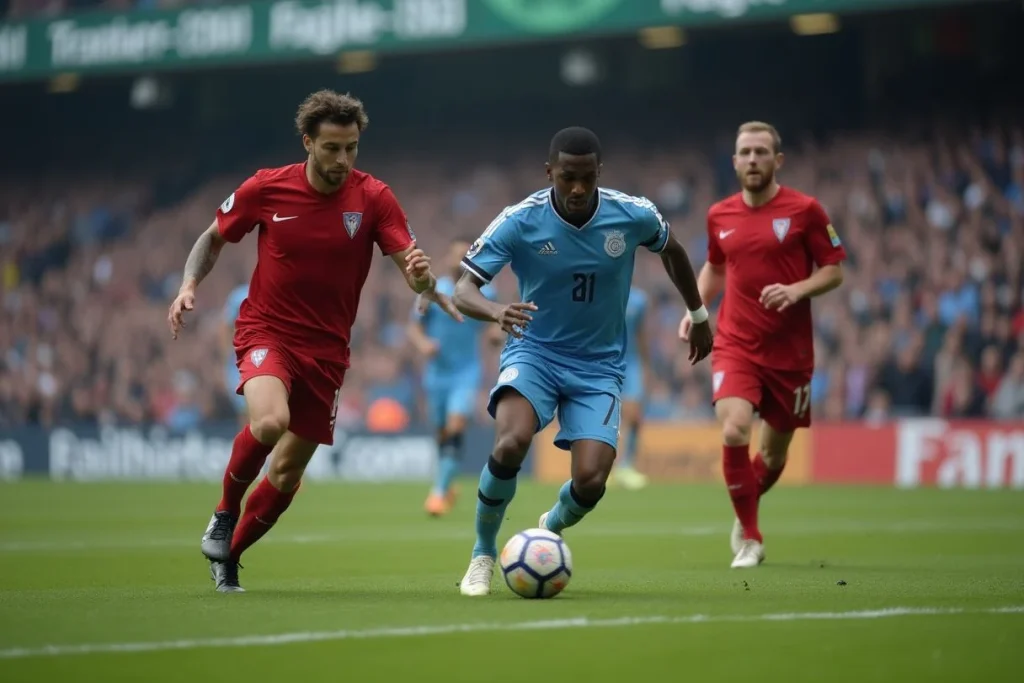
Consider the principle only, with no team or fixture attached. If opponents commit forwards to the edge of the box, a goalkeeper who joins the passing adds one more option to the build-up. That is the logic FIFA describes. Whether any given team does this, and how often it works, needs match evidence.
FIFA also notes that relying only on short passes makes a team predictable. A press that expects the short pass is the obvious way to exploit that. The 2019/20 Premier League figures covered in the previous section show the reward for a clean escape, and the next section covers the cost when it fails.
Once a named match with event data is supplied, this section can be written in full. It would cover where the press started, how the defending team’s shape responded and what happened after each short goal kick.
What turnovers at short goal kicks cost: nine goals in 288 matches
The cost side of the trade-off is small in the one season of data available to us. According to the Premier League’s season trends article, published on 19 April 2020, nine goals were conceded directly from turnovers at short goal kicks across 288 matches in 2019/20. That is a count for the whole league, not a figure for any single team, and it comes from a dated season rather than the current one.
Opta’s definition matters here. A short goal kick is one whose first pass ends less than 40m from the team’s own goal, so these turnovers happen in the most dangerous part of the pitch. Lose the ball there and the opponent is already close to goal. Nine goals is the price the source records for that exposure.
Reading the number with care
Set against the reward, the count looks modest. The same source reports that teams averaged 49m of progression after short goal kicks, against 38m after longer ones, and that every team progressed further from short goal kicks than from long ones. In our view, those figures suggest the risk was real but rare in that first season of the law change.
There are limits on what this shows. The source gives turnovers that led directly to goals; it does not, in the material supplied to us, say how many short goal kicks were taken, how many were lost, or how many led to shots without a goal. Without those totals, we cannot put a rate on the risk, and we will not estimate one.
Nor does the data say that building out causes goals conceded. It records one type of failure, not the alternative. We have no figures here for goals conceded after long goal kicks, so no direct comparison between the two choices is possible.
What a named match would add
No lineup, event or match data was supplied for any specific game, so we do not describe transitions in a particular fixture. With event data from a named match, this section could show where each turnover happened, how quickly the opponent reached the box, and how the defending side’s shape held. Until then, the nine goals in 288 matches is the sourced baseline, and it should be refreshed against current Opta data.
Our view: build out when the territory is worth the risk
This section is the publication’s view, not established fact. In our view, building out from the back is worth it when a team has the players and the structure to turn short goal kicks into territory, and not otherwise. It is a trade-off. The sourced figures show what is gained and what can go wrong, but they do not show that either choice wins matches.
The gain first. The law change allows the goal kick to be received inside the penalty area. FIFA Training Centre says that added about 640 m2 of space for build-up, which is FIFA’s own estimate. In the 2019/20 Premier League season, teams averaged 49m of progression after short goal kicks, against 38m after longer ones, and every team progressed further from short ones, according to premierleague.com. Short means the first pass ends less than 40m from the team’s own goal, under Opta’s definition. These figures are dated and are not current-season data.
The cost is turnover risk. The same source recorded nine goals conceded directly from turnovers at short goal kicks across 288 matches. That is a small number against the volume of goal kicks, but we cannot say from the data whether building out makes a team concede more or fewer goals overall. Progression and turnover risk are the only things the sources measure.
FIFA’s own view is that the goalkeeper becomes an extra outfield player against a high press. It also says that relying only on short passes makes a team predictable. That second point is why variety looks sensible to us.
FIFA’s 2019 U-20 World Cup example shows the range of approaches. Italy’s goalkeeper tended to play short, Ukraine’s mostly long, and Japan’s struck a balance, according to FIFA Training Centre. Japan’s balance is the closest fit to our reading: use the short option when the territory is there, and keep the long one to avoid being read.
Related articles

Sources
- Season trends: New goal-kick law offering risks and rewards · Retrieved October 13, 2026
- UEFA.com works better on other browsers · Retrieved October 13, 2026
- Champions League Official Live football scores & Fantasy · Retrieved October 13, 2026
- Game Insights Episode 1: Building from goal kicks – FIFA Training Centre · Retrieved October 13, 2026
- The Great Goal Kick Shift — American Soccer Analysis · Retrieved October 13, 2026
- Tactical theory: The intelligent movements of elite goalkeepers · Retrieved October 13, 2026
- Breaking Traditions: Why Serie A clubs are paving the way with defenders’ goal-kick mastery · Retrieved October 13, 2026
- why teams pass to the goalkeeper · Retrieved October 13, 2026
- Becoming a Better Fan Series: Goalkeeper passing · Retrieved October 13, 2026


Leave a Reply