A false nine is a centre-forward who starts high up the pitch but repeatedly drops into central midfield areas to receive the ball, taking him away from the opposing centre-backs. The idea is to pull defenders out of their shape or leave them with an awkward choice: follow the forward and open space behind, or hold the line and let him turn between the lines. That choice is the heart of this explainer of the false nine role in football.
Sources cite Nandor Hidegkuti, Matthias Sindelar, Michael Laudrup under Johan Cruyff and Lionel Messi under Pep Guardiola as examples, but they disagree on who first used the role, so this piece does not name an inventor. No lineups, event data or statistics were supplied for it. The sections that follow are conceptual analysis, and we label them as such until a specific match is named.
Quick answer: A false nine is a lone centre-forward, usually in a 4-3-3 or 4-1-4-1, who drops into central areas to get on the ball away from the centre-backs and drag defenders out of position. Sources cite Sindelar, Hidegkuti, Laudrup and Messi as examples, but disagree on who first used the role. Without match data, the analysis below is editorial rather than statistical.
How the false nine changes the shape of a front line
Picture a team lining up in a 4-3-3 or a 4-1-4-1. Most fans would expect the player at the top of the shape to stay high and keep the centre-backs busy. The false nine does the opposite. He starts there, then repeatedly moves towards the ball into deeper central positions. Coaches’ Voice describes the aim as getting on the ball away from the centre-backs and drawing defenders out of position.
One point first: no lineups, event data or statistics were supplied for this piece. The shapes below are a general pattern, not the formation of any particular match, and nothing here should be read as a team sheet.
What a fan sees on the pitch

According to Breaking The Lines, the role is typically played as a lone centre-forward, usually in a 4-3-3 or 4-1-4-1. That is why the false nine is often described as a front line of one that behaves like a midfielder. The visible sign is a gap at the top of the formation: the number nine is not where the shape says he should be, and the nearest centre-back has to decide what to do about it.
The decision is simple to state. Follow him into midfield and leave space behind, or stay in the back line and let him receive the ball between the lines. Neither choice is free, and that trade-off is the idea the rest of this piece builds on.
In our view, the setup is easier to spot by the shape around the forward than by his shirt number. If wide forwards and midfielders are running beyond him while he stays central and deep, the team is probably asking him to play this role. That is a reading of the concept, not a finding from match evidence.
What the false nine tries to do with the ball
No match lineups, event data or statistics were supplied for this piece, so everything below is a description of the idea, not a finding from a game. Where a claim comes from a source, it is attributed. Where it is our reading, it is labelled.
The basic pattern, as Coaches’ Voice describes it, is a centre-forward who starts high but repeatedly moves towards the ball in deeper positions, often dropping to receive centrally. The aim is to get on the ball away from the centre-backs and draw defenders out of position. That description is editorial rather than measured, and no touch or pass figures sit behind it here.
The pattern, step by step
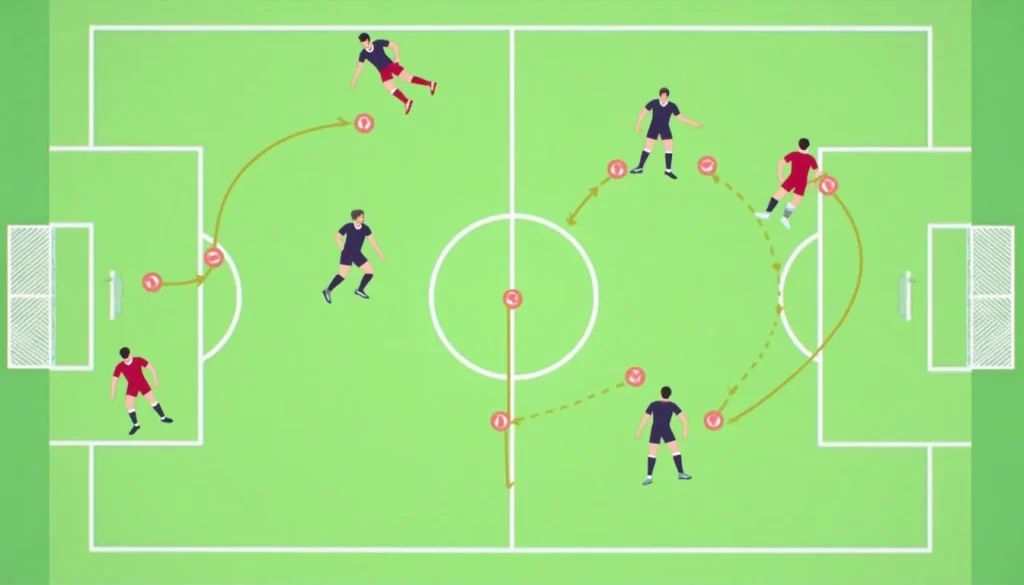
In our view, the sequence has three parts. The forward drops between the opposition midfield and defence. A centre-back then has to decide whether to follow. If he does, space opens behind him; if he does not, the forward can turn or play facing goal.
That space is where the runners come in. The role is usually described as a lone centre-forward in a 4-3-3 or 4-1-4-1, according to Breaking The Lines, which means the wide forwards and midfielders are the ones expected to arrive beyond him. The Mastermind Site says the role creates overloads in central areas. That is a claim from an analysis blog, not a measured result, and we treat it as a plausible reading rather than proof.
Examples are history, not match data
Coaches’ Voice reports that Johan Cruyff used Michael Laudrup as a false nine at Barcelona, and that Pep Guardiola later used Lionel Messi in the role there. These are reported history. No scorelines, minutes or statistics from those games are supplied here, so they illustrate the idea without proving how well it worked.
Roberto Firmino is the standard Klopp-era Liverpool example, according to PremierLeagueNow, of a false nine who also pressed centre-backs. That is editorial characterisation. How his pressing worked in practice is the subject of the next section.
One further claim, that Cesc Fabregas played the role for Spain at Euro 2012, comes from a source that has not been checked against a match report. We have left it out.
How a false nine presses and what it leaves open
Does a false nine help a team defend? In principle, yes, but the evidence supplied for this piece is conceptual. No lineups, event data or pressing statistics were provided, so nothing below rests on figures, and every claim is labelled as analysis.
The argument for the defensive value is that the role can trigger the first wave of counter-pressing when possession is lost, according to thebenchviewsoccer.com. This is editorial analysis rather than measured fact. The logic is that a forward who has dropped into midfield is already close to the ball when it is lost, so he can close down at once while team-mates squeeze in behind him. In a lone-striker shape, usually a 4-3-3 or 4-1-4-1 according to Breaking The Lines, he is the first defender.
The same sources point to the cost. Hasgoals.com says opponents can use aggressive counter-pressing to stop the ball reaching the playmaker. That is also editorial analysis. If the false nine is pressed as he receives, the side loses its link man, and the forward is then a long way from the opposing goal.
The centre-back's choice
The role puts a question to the defender, and there are only two answers.
- Follow him: the centre-back leaves the line to stay tight, which can pull the defence out of shape and open space behind for runners.
- Hold the line: the defence stays compact, but the forward receives between the lines, facing play, with time to turn.
An illustrative sketch, not match data: the false nine drops to the edge of the centre circle, the centre-back hesitates at the halfway line, and a winger or midfielder runs into the gap behind.
Allaboutfootball.net adds that the tactic is said to be vulnerable against three centre-backs, who can cover central space without being dragged out of position. The same source says the role depends on runners and a compact side. In our view, that makes the press and the shape behind it the real test of the role.
Where the role is most exposed when possession changes hands
No match data was supplied for this piece, so nothing here describes a real game. What follows explains the concept and labels where each claim comes from.
The risk in transition starts with the false nine’s own job. When he drops from a high starting position to receive between the lines, he leaves the space behind the defence. If the ball is lost while he is deep, the team has fewer players near the opposing centre-backs. The opponent’s first pass forward then has more room to travel. That is an explanation of how the role works, not a measured result.
The same movement is also said to help. Thebenchviewsoccer.com says the role triggers the first wave of counter-pressing when possession is lost. The idea is that a forward already close to the ball can close down the player who has just won it. Opponents have an answer, though. Hasgoals.com says they can use aggressive counter-pressing of their own to stop the ball reaching the playmaker in the first place.
What the role depends on
Allaboutfootball.net says the role fails as often as it succeeds and depends on runners and a compact side. Compactness matters most in the moments after a turnover, because short distances between players make it easier to win the ball back quickly. Runners matter because the forward’s drop only pays off if a team-mate attacks the vacated space.
The same source says the tactic is vulnerable against teams with three centre-backs. One of them can step out to follow the forward while the other two keep their shape, so central space is covered without anyone being pulled out of position. Thebenchviewsoccer.com makes a related case about the risks of the role. Both views are editorial commentary, not tested against match data.
In our view, the numbers needed to test any of this would be turnovers in the middle third and what followed them. Until a specific match is named, that evidence is not available.
Our view: when a false nine is worth the risk
This section is the MatchOf view. It is editorial judgement built on the conceptual material above, not a finding from match data, and none was supplied for this piece.
In our view, the false nine is worth the risk only when a team has solved the problem the role creates. The forward leaves the centre-backs with a choice: follow him and open space behind, or hold and let him receive between the lines. Whichever they pick, someone else has to exploit it. According to allaboutfootball.net, the role depends on runners and a compact side, and it is said to fail as often as it succeeds. We think that is a fair warning for anyone treating the shape as a shortcut.
What a team needs before trying it
- Runners. If the striker drops and nobody attacks the vacated space, the defenders have lost nothing by following him or by staying put.
- A compact side. A forward who drops deep also pulls the team’s own shape up the pitch, so the distances between lines have to stay short.
- A plan for the space left behind. The gap the forward creates is only useful if a teammate is ready to use it.
The same source says the tactic is vulnerable against teams with three centre-backs, who can cover central space without being dragged out of position. As an editorial judgement, we would expect the role to be less effective against that kind of back line, because the dilemma it is meant to create is weaker when there is an extra defender to hold the line.
None of this makes the false nine good or bad in absolute terms. It is a trade, and the evidence to price it, such as turnovers in the middle third and what followed them, only exists once a specific match is named.
Related articles


Sources
- The False Nine Soccer: origin and strategy explained – Barça Academy US · Retrieved October 13, 2026
- The false nine: explained – Coaches' Voice · Retrieved October 13, 2026
- False Nine · Retrieved October 13, 2026
- What Is a False Nine? Tactical Terms Explained for Normal Fans · Retrieved October 13, 2026
- How to play with a False 9 like Guardiola and Klopp · Retrieved October 13, 2026
- False 9 Explained: Role, Tactical Impact and Legendary Players · Retrieved October 13, 2026
- Soccer's False Nine Position: Definition and Tactical Role · Retrieved October 13, 2026
- The Evolution of the False 9 Role – Breaking The Lines · Retrieved October 13, 2026
- The True Origin of the False Nine Role in Soccer Revealed · Retrieved October 13, 2026
- The Art of the False Nine: From Messi to Modern Variations · Retrieved October 13, 2026
- Why Teams Use a False Nine: Lessons from Barcelona and Liverpool · Retrieved October 13, 2026
- Why Top Teams Like LFC Use A False Nine – Tactical Theory · Retrieved October 13, 2026
- The False 9: A Tactical Revolution in the Premier League – PremierLeagueNow · Retrieved October 13, 2026
- Why the False Nine Is Not a Striker: Roles, Risks and When Teams Should Use It · Retrieved October 13, 2026
- 202526 Premier League · Retrieved October 13, 2026
- 202526 Arsenal F.C. season · Retrieved October 13, 2026
- 202526 Premier League of Bosnia and Herzegovina · Retrieved October 13, 2026
- 202526 EFL Cup · Retrieved October 13, 2026


Leave a Reply