
The low block, mid block and high block differ in one basic way: how far up the pitch a team defends once it loses the ball. A low block protects the defensive third, a mid block holds the middle third, and a high block tries to win possession in the attacking third. That difference in starting position also shapes when a team steps out to press and how much space it leaves behind it.
This guide sets out the low block mid block high block difference in plain terms, then explains what evidence is needed to say which one a team is using. No match is attached to this piece, so it makes no claims about the shape, pressing or statistics of any named side. Those claims need lineups and event data from specific matches. One measure is covered later: PPDA, passes allowed per defensive action, the usual metric for pressing intensity.
Quick answer: A low block sits deep to protect the defensive third, keeping its units close together and limiting space in behind. A mid block defends the middle third, aims to block central lanes, and steps out to press on triggers such as a poor touch or a backward pass. A high block pushes the team up to win the ball in the attacking third, usually after slow or backward passes.
Where each block sits: the three shapes side by side
The three blocks are defined by one question: how far up the pitch does the team choose to defend? The answer sets where the defensive line stands, how far the midfield sits from it, and how much grass the opposition has to play in.
Low block: the defensive third
In a low block the team sits deep to protect its own defensive third. According to Coaches’ Voice, the units stay close together and the aim is to limit space in behind the defence. The attacking side has the ball and the territory, but little room to use it near goal.
Mid block: the middle third
A mid block holds the middle third. The England Football Learning community describes its aim as blocking the central lanes, with the team stepping out to press on triggers such as a poor touch or a backward pass, while a teammate covers behind the player who steps out. In plain terms, the team waits in its shape and only presses when the opponent gives it a reason to.
High block: the attacking third

A high block, often called a high press, pushes the team up to win the ball in the attacking third. FourFourTwo identifies slow or backward passes as typical triggers. Coaches’ Voice groups all three blocks as defensive strategies a team adopts once it has lost the ball, not as fixed identities.
What compactness means
Compactness is the thread running through all three. It means keeping the gaps between defence, midfield and attack small, so the opponent cannot pass between the lines. Only the location changes: a low block is compact near its own goal, a high block compact far from it.
As an illustration only, not a stored lineup, picture a 4-4-2. In a low block, its two banks of four sit near the penalty area with the strikers just inside their own half. In a high block, the same eleven players shift up the pitch, with the strikers pressing the opposing centre-backs.
How teams play through a low block
Against a low block, the attacking team has the ball but little room. The defence sits close to its own penalty area, keeps its lines tight and limits space in behind, so a long pass or a quick run rarely works. The task becomes one of patience: moving the block around until a gap opens.
What follows is the publication’s analysis of the general approaches, not a finding from any one match.
The usual routes through
The first is width. Moving the ball to the flanks asks the block to shift sideways, and a compact unit that stretches to cover the wing can leave space between its lines. Crosses and cut-backs are the typical outcome once that space appears.
The second is combination play between the lines. Short passes into a midfielder or forward positioned between the defensive and midfield banks force a defender to step out, and that step can leave a gap behind him.
The third is patience. Circulating the ball with little risk can tempt defenders out of position, and the attacking side keeps cover behind the ball so that a lost pass does not become a counter-attack. Coaches’ Voice, which describes the low block as a deep, compact defensive strategy, uses managers such as Diego Simeone and Sean Dyche as background examples. Their current status has not been checked here, so they are not treated as live case studies.
What the data would need to show
No match is attached to this piece, and no possession, passing or completion figures are stored. That means no claim can be made here about how any named team breaks down a deep defence. To support a pattern claim in a specific match, we would want the share of attacks down each flank, the number and location of crosses, and passes received between the lines. Without those, a description of a team’s approach is opinion, not evidence.
When a team steps out to press: triggers and measurement
A team leaves its block when the opponent gives it a reason to. Those reasons are called pressing triggers, and they are what separate a team that sits in a shape from one that hunts the ball from it.
In a mid block, the trigger is typically a poor touch or a backward pass, according to the England Football Learning mid-block guide published by The FA. The player who steps out to press does not go alone: the guide stresses cover behind the presser, so that if the first man is beaten, a team-mate is already in position. Coaches’ Voice, in its mid-block explainer, treats the same shape as a strategy a team adopts once it has lost the ball, with the aim of controlling the middle third rather than winning possession high up.
A high block uses similar cues further up the pitch. FourFourTwo describes it as pushing the team up to win the ball in the attacking third, with slow or backward passes as the signals to close down. The distinction is where the press starts, and how far the team is prepared to stretch to do it.
Measuring the press
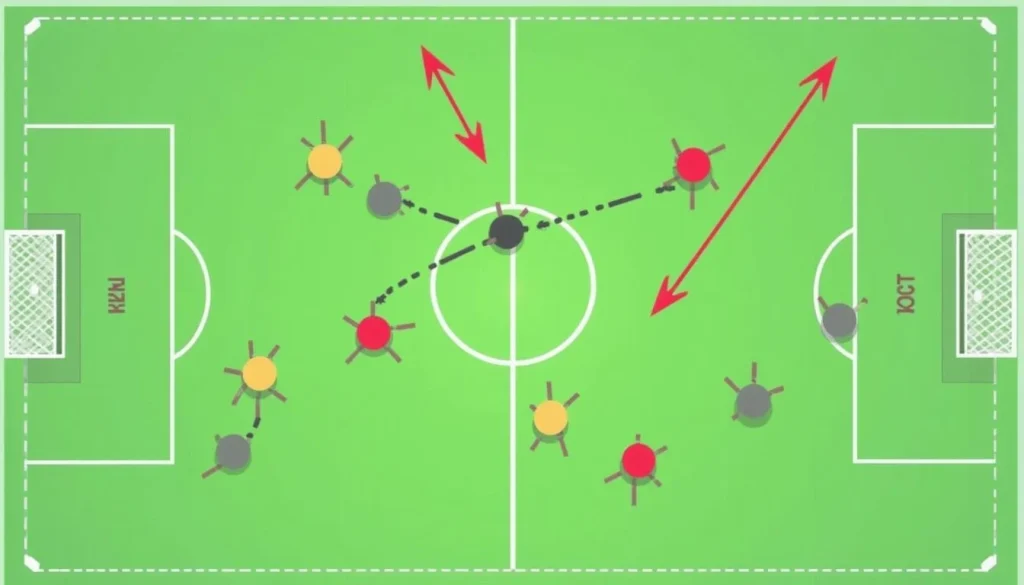
The usual measure of pressing intensity is PPDA, or passes allowed per defensive action. It counts how many passes a team lets the opponent make before it attempts a tackle, interception or similar action. A lower figure means the team intervenes sooner. According to a Medium summary, the metric was developed in a 2014 StatsBomb article; we have not seen the original, so that origin rests on the secondary source.
Thresholds are looser than the metric itself. The Barcelona innovation hub describes a PPDA below 8 as aggressive pressing. That is one source’s rule of thumb, not an accepted standard, and it should not be used to sort teams into categories.
Two cautions apply. PPDA depends on how a data provider defines defensive actions and passes, so figures from different providers are not directly comparable. It also says nothing about where the press happens or what triggered it. In our view, a PPDA number is a starting point that needs event locations alongside it. No match data is loaded for this piece, so no team’s figure is given here.
What happens when the ball is won back
Every block ends the same way: someone wins the ball, and the shape that defended has to become a shape that attacks. What differs is where the ball is won, and that changes what the next pass can achieve.
A high press aims to win possession in the attacking third. According to FourFourTwo, the team presses on triggers such as slow or backward passes, so a turnover there starts the next move close to goal. The defenders who stepped up have little distance to cover. The risk is the reverse: if the press is beaten, a lot of space sits behind it.
A low block works the other way round. Coaches’ Voice describes it as a way to protect the defensive third, with the team sitting deep, keeping its units close together and limiting space in behind. When the ball is won there, the attackers are a long way from the opposition goal. The counter-attack therefore depends on how quickly the team can move the ball out and how much room the opponent leaves behind its own line.
The mid block sits between the two. The England Football Learning material describes it as defending the middle third and blocking central lanes, with cover behind the player who steps out to press. A ball won there can go forward quickly, but the team is also better placed to hold on to it.
These are general principles, not findings about any team. No event data from a named match is attached to this piece, so we do not describe real turnovers, counters or shots. In our view, a team’s transitions can only be judged once event-level evidence is added: where each ball was won, how many passes followed and how the move ended.
Verdict: the publication's view on reading a team's block
This section is the publication’s editorial view. It is opinion, not a finding from a match, and it should be read that way.
In our view, a team’s block is best judged by two questions: where does the defence sit, and what makes it step out to press? A single label such as “low block” or “high press” hides too much. The same side can sit deep in one phase and press high in the next, and the broad definitions still hold. A low block protects the defensive third, a mid block defends the middle third, and a high block tries to win the ball in the attacking third. Coaches’ Voice also treats all three as strategies a team adopts after losing the ball, which supports reading them as responses to a situation rather than fixed identities.
We must be plain about the limits here. No match is attached to this piece, so this view is not backed by lineups, events or statistics, and we do not name any team as using a particular block. Anyone who wants to apply the idea to a real side needs three kinds of evidence:
- Average defensive positions: where the back line and the midfield sit when the opponent has the ball, taken across a match and not from a single frame.
- Pressing triggers in event data: what happened immediately before the team stepped out, such as a poor touch or a backward pass, and whether cover was set behind the presser.
- PPDA, with its definition stated: passes allowed per defensive action, the usual measure of pressing intensity. It was developed in a 2014 StatsBomb article, according to a Medium summary, and it only has meaning when the pitch zone and the sample of matches are given alongside it.
Until that data is loaded, the three blocks are a vocabulary for asking better questions, not a verdict on any team.
Related articles

Sources
- Control, Cover and Be Compact: Tactics of a mid-block – Insight and analysis – England Football Learning – The England Football Community · Retrieved October 13, 2026
- The low block: football tactics explained – Coaches' Voice · Retrieved October 13, 2026
- The mid-block: football tactics explained – Coaches' Voice · Retrieved October 13, 2026
- Understanding low block vs Mid block in football – Wavysport · Retrieved October 13, 2026
- Low Block Football: What It Is, Why It Works and How to Break It – The PFSA · Retrieved October 13, 2026
- Mastering Football Tactics: How to Create a Mid-Block – The Titans Football Academy · Retrieved October 13, 2026
- Mid-Block – Football Tactics Explained – The Football Analyst · Retrieved October 13, 2026
- Controlling the game without the ball: The mid-block and compactness – FIFA Training Centre · Retrieved October 13, 2026
- Low Block in Football: What It Is, How It Works, How to Beat It — KiqIQ · Retrieved October 13, 2026
- Low Block in Football Explained · Retrieved October 13, 2026
- How to make a mid-block mid – by Billy Carpenter · Retrieved October 13, 2026
- Mid-Block in Modern Football: How Compactness Shapes Elite Defenses · Retrieved October 13, 2026
- Tactics Explained – Understanding Different Defensive Blocks · Retrieved October 13, 2026
- Breaking Down Mid Block Football · Retrieved October 13, 2026
- Mid Block in Soccer: A Comprehensive Guide · Retrieved October 13, 2026
- The high press: football tactics explained · Retrieved October 13, 2026
- Quantifying the Intensity of High-Press Tactics in Football with PPDA · Retrieved October 13, 2026
- High Pressing in Football: PPDA and Pressure Metrics · Retrieved October 13, 2026
- High-Block · Retrieved October 13, 2026
- How the High Press Works in Football — Tactics, History & Data Explained · Retrieved October 13, 2026
- High press football explained: How the High Press Works in Modern Football · Retrieved October 13, 2026
- PPDA Explained – ThePressingZone · Retrieved October 13, 2026
- PPDA in Football Explained: 3 Smart Pressing Numbers · Retrieved October 13, 2026
- The Difference Between Low Block, Standard Block, & High Block In Football · Retrieved October 13, 2026



Leave a Reply