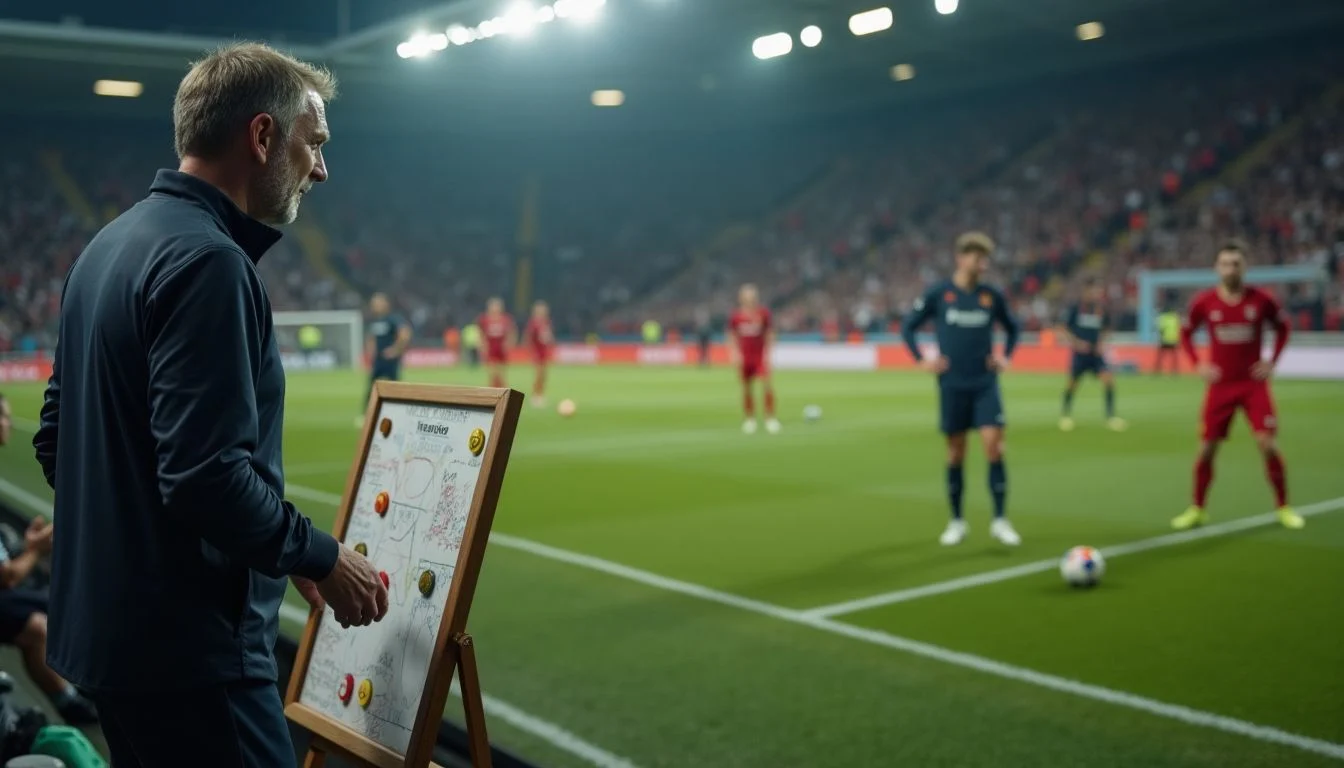
Inverted full-backs are full-backs who move into central areas in possession, usually during build-up, so that their team can build a central-midfield overload while the wingers hold the width. The idea is often traced to Johan Cruyff, and Pep Guardiola is widely credited with reviving it. Philipp Lahm at Bayern Munich is one of the best-known early examples. This analysis sets out what is reported about the role and where the evidence stands: the stored data for this piece contains no lineups, event feeds or match statistics, so it does not make match-level claims about shape, possession or transitions.
One reference point comes with a date. In the 2023/24 Premier League season, 4-2-3-1 and 4-3-3 made up 65.4% of starting XIs after 12 matches. That is a figure for that season only, and it is not a current measure of how teams line up. Where the evidence is reported rather than confirmed, or is the publication’s own reading, the text says so.
Quick answer: An inverted full-back is a full-back who moves into central areas during possession, usually in build-up, to create a central-midfield overload while the wingers keep width. Guardiola is widely credited with reviving the role, with Cruyff cited as an earlier user and Lahm as an early example at Bayern Munich. Match-level shape claims are still pending, because no lineup or event data has been gathered for this piece.
Where the role came from and who popularised it
The role has a longer pedigree than its recent prominence suggests. According to FourFourTwo, Johan Cruyff is cited as an earlier user of the idea, while Pep Guardiola is widely credited with reviving it. That is a reported attribution rather than a match-verified record, and this piece holds no lineup or event data from the Cruyff era to test it.
The clearest early example in the sources is Philipp Lahm at Bayern Munich. GiveMeSport describes Bayern’s in-possession shape under Guardiola as a 2-3-5, with Lahm stepping inside. It adds that the shape became a 3-2-5 when David Alaba also inverted. The difference matters: with one full-back inside, the back line behind him is narrower and the midfield gains a body. With two, the structure shifts again.
Guardiola did not always invert both full-backs. FourFourTwo notes that he has sometimes inverted only one, which is a reminder that the role is a choice made match by match rather than a fixed template.
What this section can and cannot claim is worth stating plainly. The shapes above are descriptions from published analysis, not figures taken from team sheets or tracking data stored by MatchOf. They explain how the role is understood to have developed, and the sections that follow treat them in the same way, as sourced descriptions pending match-level evidence.
Shape and setup: where the inverted full-back sits
Which formations use the role? The one league-wide shape figure we can source is dated and limited. In the 2023/24 Premier League season, after 12 matches, 4-2-3-1 and 4-3-3 made up 65.4% of starting XIs, according to premierleague.com (17 November 2023). That is a 12-match sample from nearly three seasons ago, not a current figure, and it should be checked against the source page before anyone quotes it as the present picture.
The number matters for one reason. Both shapes start with a back four and a flat or near-flat midfield line, so a full-back who steps inside has company in the middle. It says nothing about how many of those teams inverted a full-back, or how often. The source does not break that down, and neither can we.
MatchOf has no match lineups, events or tracking data stored for this piece. No claim in this section is therefore tied to a particular fixture, and none should be read as one.
What the shape looks like on paper
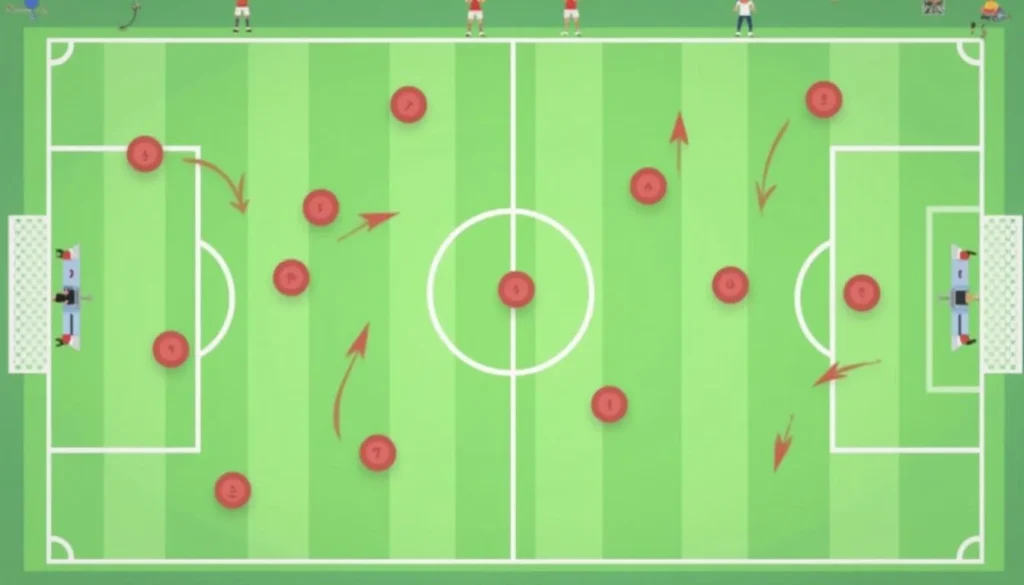
The reading below is editorial, drawn from tacticalfootballanalysis.com (28 May 2026). In a 4-3-3 on paper, an inverted full-back turns the build-up into a 3-2 or a 2-3. With one full-back inverting, the back line drops to three, with two midfielders ahead of it. With both inverting, two centre-backs sit behind a three-man central line.
The setup carries a variation. Guardiola has sometimes inverted one full-back rather than two, according to FourFourTwo. The starting lineup on a team sheet would look identical in both cases. Only positioning data, which we have not stored, would separate them.
In possession: the central overload and the width behind it
In build-up, an inverted full-back leaves the touchline and takes up a central position, usually between or alongside the midfielders. According to Coaches’ Voice, the stated purpose is a central-midfield overload, with the wingers holding the width the full-back has given up. The role changes who occupies the middle of the pitch, not just where the full-back stands.
Oleksandr Zinchenko, whom Mikel Arteta has used in the role at Arsenal according to jobsinfootball.com, has described the job himself. On arsenal.com he set out three things: reading the opposing winger’s position, finding space and playing forward, and knowing what is behind you before receiving the ball. The page carries a date of 23 January 2026, but the interview itself may be older, so the timing of his comments should not be assumed. His description is of a player scanning and positioning before the ball arrives, not one waiting for it.
What the statistics can support

Here the evidence is thin, and we say so plainly. One source, themastermindsite.com, predicts that inverted full-backs should show high pass, progressive-pass and central-touch volumes. That is an expectation, not a measured finding. We have not gathered player-level pass or touch data, so we cannot confirm it for any named player.
The only stored figure on shape is from the Premier League’s own site. After 12 matches of the 2023/24 season, 4-2-3-1 and 4-3-3 made up 65.4% of starting XIs. It is a season-specific count of starting formations, and it does not show how often full-backs inverted.
Arsenal's full-backs: reported, not yet verified
Coaches’ Voice reports that Arsenal’s 2025/26 left-back Riccardo Calafiori has inverted from the left in deeper build-up and against low blocks, while Timber overlaps or inverts depending on the situation. These are secondary-analysis descriptions. They need match-level confirmation from event or positional data before we treat them as established patterns.
Out of possession: rest defence and the block
Without the ball, the case for the inverted full-back rests on one idea: rest defence. Footballanalysishub.com credits the role with providing it, meaning that players already positioned centrally are placed to deal with the first counter-attack once possession is lost. That is a description of purpose rather than a measured outcome, and in our view it should be read that way. No stored lineup, event or positional data in this brief shows how often it works.
The Arsenal reading
Coaches’ Voice, in its Arsenal analysis published on 21 November 2025, describes a side that recovers into a 4-4-2 out of possession and holds a high line with William Saliba and Gabriel. This is the analyst’s interpretation, not a stored match record. It needs match-level evidence, such as team sheets and positional data, before it can be treated as a fixed pattern. We have not seen that evidence, so we present the shape as a reading only.
If the description is accurate, the 4-4-2 would mean the inverted full-back’s job changes once the ball is lost. He would have to leave the central zone and rejoin the back four or the wide midfield line. How quickly he does so, and from which positions, is exactly what the data does not yet show.
The stated trade-off
The cost is reported plainly. According to The Bench Viewsoccer, a loss of possession can leave space behind an inverted full-back. A full-back who has moved inside is no longer guarding the flank, so a turnover can expose the channel he left, especially if the opposing winger has stayed wide.
This links to the point Oleksandr Zinchenko made in the Arsenal interview: a player in this role must know what is behind him before he receives the ball. The quote is about preparation, not defending, but it points at the same risk.
What would settle the question is how many counter-attacks originate down the vacated side, and how many shots they produce. Those figures have not been gathered for this piece.
Transitions: what the event data can and cannot yet show
The question left open above is a transitions question, and it is one the event record would answer directly. This piece has no stored match events, so it cannot yet say whether teams that invert a full-back concede more in the seconds after a turnover, or win the ball back faster. Anything resembling a count, a recovery time or a shot tally would be invented.
What can be stated is the stated trade-off of the role. Bench Viewsoccer’s analysis of Arsenal’s full-backs reports that a loss of possession can leave space behind an inverted full-back. That is a reported claim from a secondary analysis, not a measured finding. A second, separate claim comes from Football Analysis Hub, which credits inverted full-backs with providing rest defence. In our view, the two ideas pull in different directions, and only event data can show which one dominates in a given team.
What the desk needs to retrieve
Before any transition claim is made, these event types are required, ideally from an official league data feed or a named provider such as Opta or StatsBomb, with the provider stated on publication:
- Possession losses by the inverting full-back, with pitch location and minute.
- Ball recoveries in the half-spaces and central areas the full-back occupies.
- Counter-press actions within a few seconds of a loss, with the window defined in advance.
- Opposition shots and counter-attacks that begin on the flank the full-back vacated.
- Team shape at the moment of loss, taken from tracking data or official team sheets.
Any counter-attack reasoning until then is hypothesis: if space behind the full-back is a weakness, it should show up as a higher share of opposition attacks down that side. The data may show otherwise.
Verdict: the publication's editorial view
This section is the publication’s editorial view, not established fact. It rests on sourced descriptions of the role and on the match-level evidence listed above, which is still to be gathered. Our confidence is moderate on the role’s purpose and low on how often it succeeds.
In our view, the inverted full-back is best read as a midfield-control and rest-defence tool rather than a pure attacking device. The stated purpose, per Coaches’ Voice, is a central-midfield overload while wingers keep width. FourFourTwo describes Arsenal’s use of the role under Mikel Arteta as perhaps more defensive than attacking in purpose, and that description is itself editorial. Footballanalysishub.com likewise credits inverted full-backs with providing rest defence when the team is out of possession. The three accounts point the same way, but none is backed by event data we hold.
The trade-off is the one the previous section left open. Bench Viewsoccer states that a loss of possession can leave space behind an inverted full-back. Whether that space is exploited more often than it is covered is a question for tracking data, not for opinion.
Zinchenko’s own description, published by arsenal.com, supports the cautious reading. He framed the job as reading the opposing winger’s position, finding space and playing forward, and knowing what is behind you before receiving the ball. Half of that is defensive awareness.
Bench Viewsoccer also reports that the role is splitting into sub-roles such as the half-back and the eight-back. That is a reported trend, and we have not confirmed it. If it holds, a single label will describe less and less.
What would change our view: evidence that teams using the role concede fewer central entries, or that their inverted players record the high progressive-pass and central-touch volumes that one source predicts. Until then, this is a reasoned reading, not a finding.
Related articles


Sources
- Season trends: Inverted full-backs providing tactical flexibility · Retrieved October 13, 2026
- The inverted full-back: football tactics explained · Retrieved October 13, 2026
- Coaches' Voice · Retrieved October 13, 2026
- Mikel Arteta Tactics Explained · Retrieved October 13, 2026
- Zinchenko on how to play as an inverted full-back · Retrieved October 13, 2026
- How the role of the fullback is changing: the main tactical trends of the season · Retrieved October 13, 2026
- Why Arsenal's Full-Backs Are Key to Their Attacking Shape · Retrieved October 13, 2026
- Arsenal 2025-26: Tactical Evolution and Playing Styles After a Revolutionary Summer – ArsenalNews.co.uk · Retrieved October 13, 2026
- How Arsenal's Full-backs Balance Attack and Defensive Shape · Retrieved October 13, 2026
- Explaining the Inverted Fullback · Retrieved October 13, 2026
- Inverted Full-Backs in Football (Explained) · Retrieved October 13, 2026
- Inverted full-backs: football tactics explained – Coaches' Voice · Retrieved October 13, 2026
- The Rise of the Inverted Full-Back: How Oleksandr Zinchenko Reveals the Future of Football Tactics · Retrieved October 13, 2026
- 4-3-3 (Inverted Fullbacks) Formation Explained — Shape-Shifting Tactics · Retrieved October 13, 2026
- Evolution of the Inverted Fullback: March 2026 Tactical Trend Report … · Retrieved October 13, 2026
- What Are Inverted Full Backs? How & Why Teams Use Them… · Retrieved October 13, 2026
- Inverted Fullbacks vs Overlapping: 5 Smart Truths (2026) · Retrieved October 13, 2026
- Oleksandr Zinchenko (footballer) · Retrieved October 13, 2026
- Myles Lewis-Skelly · Retrieved October 13, 2026




Leave a Reply