
Half-spaces are the two vertical lanes that sit between the wide areas and the central lane when a pitch is divided into five channels, a convention described by Coaches’ Voice and FourFourTwo. This half-spaces football explained guide uses plain language to answer the questions fans ask most: where the zone is, why attackers want the ball there, and why defenders find it awkward to guard.
The idea is easiest to picture as a gap. The half-space lies roughly between the centre-back and the full-back, so a player who receives the ball there leaves defenders to decide who steps out and who holds their position. FourFourTwo cites right-footed playmakers such as Kevin De Bruyne and Trent Alexander-Arnold as examples of players who work the right half-space. That is an illustration only, not a statement of their current roles.
This is a general explainer. No specific match, lineup or statistic is used, so nothing below is presented as match evidence, and any judgement is labelled as our own view.
Quick answer: Half-spaces are the two vertical lanes between the wide areas and the central lane when the pitch is split into five lanes, a convention described by Coaches’ Voice and FourFourTwo. They sit roughly between the centre-back and the full-back, and teams often try to receive the ball there in the final third. This piece covers general principles only, because no specific match, lineup or statistic is supplied.
What a half-space is and where it sits on the pitch
Picture the pitch cut into five vertical strips running from goal line to goal line, like lanes on a running track. The two outer strips are the wide areas, where wingers and full-backs hug the touchline. The middle strip is the central lane, straight down the spine of the pitch. The half-spaces are the two strips in between.
Coaches’ Voice numbers the five lanes 1 to 5, from one touchline to the other. On that numbering the half-spaces are lanes 2 and 4. This is a coaching convention, not a rule in the laws of the game, and not every analyst draws the lanes the same way. Coaches’ Voice and FourFourTwo both describe the half-spaces as the lanes between the wide areas and the centre.
FourFourTwo describes the zone in terms of defenders: the half-space sits between the centre-back and the full-back. That is the gap a back four can struggle to own, because each defender can reasonably expect the other to deal with it. This is the outlet’s descriptive framing, not a measured fact about any particular team.
Why it matters is simple. Coaches’ Voice notes that teams look to receive the ball in the half-space in the final third, around the edge of the box. From there a player is close to goal and can face several ways: a pass into the box, a shot, or a ball out wide.
Terms such as “wide areas” and “central lane” are used throughout this piece in exactly this sense.
Shape and setup: how formations open the lanes
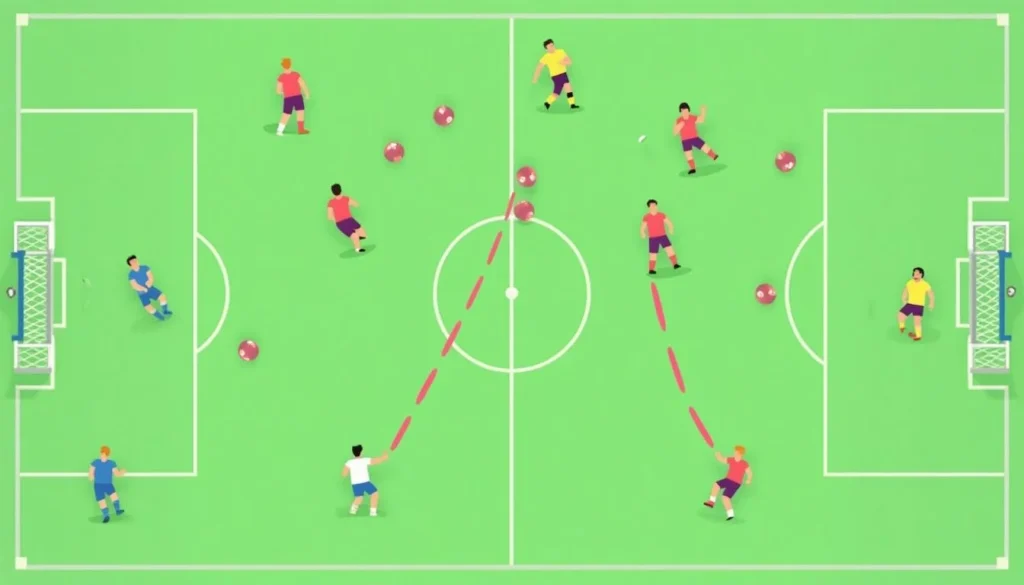
Some formations leave more room in the half-spaces than others, and the reason is mostly about where the players stand. Football DNA, a specialist site, says a 4-3-3 with wide wingers is said to open space in those lanes. That is one source, so treat it as a description of a tendency rather than a rule.
The logic is simple. In a 4-3-3, two wingers hold the touchline in the wide areas, and a single striker occupies the central lane. That leaves the two lanes in between, the half-spaces, with no forward standing in them at the start of a move. The wingers also pull the opposing full-backs outward to mark them, which can widen the gap between full-back and centre-back. That gap is where, according to FourFourTwo, the half-space sits.
Who then uses the vacated lane? In a 4-3-3, the natural candidates are the three central midfielders, who can step forward from the middle. FourFourTwo names right-footed playmakers such as Kevin De Bruyne and Trent Alexander-Arnold as examples of players who operate in the right half-space. That is an illustration of the type of player involved, not a statement about their current roles or the teams they play for.
A picture helps here. An editorial diagram of a generic 4-3-3, with the five lanes marked and the two half-spaces shaded, would show the empty pockets between each winger and the striker. It would be an illustration of the idea, not a real match or lineup.
No lineup or statistic is available for this piece, so none of this describes what any particular team does. It is the general shape of the idea. For a deeper study of shapes and lanes, a tactics coaching book is a natural next read for anyone who wants to go further.
In possession: how teams look to use the lane
When a team has the ball near the opponent’s box, the half-space is one of the zones it looks to reach. Coaches’ Voice, which splits the pitch into five vertical lanes, describes the half-spaces as lanes 2 and 4, the two strips between the wide areas and the centre. That numbering is a coaching convention, not an official one. In our view, the logic is simple: a player here is not tucked in front of the centre-backs and not pushed out near the touchline.
Coaches’ Voice says teams look to receive the ball in the half-space in the final third, around the edge of the box. FourFourTwo places the zone between the centre-back and the full-back. A player who gets the ball there can face the goal and attack the defence from an angle, with passing options on both sides and the goal within range.
The zone also puts a question to the defenders. According to FourFourTwo, when an attacker occupies the half-space, the back line has to decide who covers the gap between centre-back and full-back. If the centre-back steps out, space opens behind him. If the full-back tucks in, the wide area is left free. The attacker’s position creates the problem before he touches the ball.
The same lane suits a playmaker who wants to link play. FourFourTwo gives right-footed playmakers such as Kevin De Bruyne and Trent Alexander-Arnold as examples of players operating in the right half-space. These are illustrations of the idea from a 2025 explainer. They are not a statement of either player’s current role, and no statistics or match evidence support them here.
Out of possession: how defenders close the gap

Defending the half-space is a question of responsibility. According to FourFourTwo, when an attacker occupies this lane, defenders have to decide who covers the gap between the centre-back and the full-back. The difficulty is that the lane belongs to neither of them. If both step across, they leave space elsewhere. If neither does, the attacker receives the ball with time to turn.
There are a few general ways to answer it. None is tied to a named team here, and no data is offered on how often any side uses them. They are principles, in our view, not findings.
- A midfielder shifts across. A central midfielder drops into the lane to pick up the runner, which keeps the back line intact but pulls a player away from the middle.
- The full-back steps in. The full-back moves inside to meet the attacker, which closes the lane but can leave the wide area open behind him.
- The centre-back holds position. The centre-back stays in the middle of the goal area and trusts the players around him to deal with the lane, which protects the box but gives the attacker room to receive.
Each choice trades one risk for another. In our view, that trade-off explains why the half-space is valued. It forces defenders to make a decision, and it can expose a hesitation between two players.
Not every team will answer the same way, and the sources supplied do not say which approach is more common. What matters for a casual fan watching is simple: when an attacker receives the ball between a centre-back and a full-back, look at which defender moves first.
Transitions: when the lane matters most
The half-space matters most in the seconds after the ball changes hands. In settled play, a defence has time to set its lines and decide who covers which gap. Straight after a turnover, that organisation may not yet be in place.
This is general explanation, not a description of any match. No event data has been supplied for this piece, so there is no counterattack count or timing figure to cite.
The logic is simple. When a team wins the ball, its opponents are often still arranged for attack, with a full-back pushed forward and the central defenders drifting to cover. The space between a centre-back and a full-back, which FourFourTwo describes as the half-space’s position, can open quickly. An attacker arriving in that lane may receive the ball with defenders facing the wrong way or unsure who should step across.
The same applies in reverse. A team that loses the ball with its own players committed forward can find the lane exposed behind them. In our view, this is why coaches often talk about protecting the half-spaces even when their side is attacking: the lane is a risk as well as an opportunity.
The question from the previous section still applies here. Watch which defender moves first, and how much time the attacker has when the ball arrives.
Verdict: our editorial view on the concept
This section is the MatchOf editorial view. It is opinion, not sourced fact.
In our view, the half-space is a useful idea for reading football, and a limited one. It gives a casual fan a simple question to ask during a game: who is standing in the gap between the centre-back and the full-back, and who has to deal with them? Coaches’ Voice and FourFourTwo both describe the lane in this way, and the question travels from one match to the next.
The limit is that the term describes a zone, not a tactic. Nothing about the label guarantees that a team will use the lane well, or at all. Teams reach it in different ways. One source, Football DNA, says a 4-3-3 with wide wingers opens space there, but that is a weaker source and we treat the claim as a suggestion, not a rule. The outcome depends on the formation and on the players who occupy the lane.
Readers should also weigh the material behind the concept. The numbering of the lanes, with the half-spaces as lanes 2 and 4, comes from one source, Coaches’ Voice, and is a convention rather than an official standard. The player examples, Kevin De Bruyne and Trent Alexander-Arnold, come from a FourFourTwo explainer and are illustrations, not a description of their roles today.
Treat the half-space as a way of seeing the pitch. It is not a formula for winning.
Related articles
Sources
- The half-spaces: football tactics explained – Coaches' Voice · Retrieved October 13, 2026
- Half-space: football tactics explained · Retrieved October 13, 2026
- TACTICS: Exploit The Half Spaces To Dominate Your Opponents · Retrieved October 13, 2026
- Half Spaces in Football: Analysis & Technichs · Retrieved October 13, 2026
- Half-Spaces · Retrieved October 13, 2026
- Mastering Football Half Spaces: Strategies for Success · Retrieved October 13, 2026
- Understanding Half-Spaces · Retrieved October 13, 2026
- How to Use the Half-Spaces · Retrieved October 13, 2026


Leave a Reply